
At a Glance: The Ten Standard Firefighting Orders are fundamental safety rules that every firefighter must follow during fire operations. These orders form the backbone of firefighter safety protocols and are designed to prevent accidents and save lives.
In the aftermath of several tragic fires in the early 1900s, the U.S. Forest Service recognized the need for standardized safety protocols. The Ten Standard Firefighting Orders were established by a task force in 1957 as a set of clear, actionable rules that remain just as relevant today as they were over 60 years ago.
These orders serve as non-negotiable guidelines for firefighters across the United States, from rookie crew members to seasoned veterans. They apply to all fire situations, whether it’s a residential blaze or a wildland firefighting incident. Each one is used in practical applications to continue to protect firefighters in modern fire operations.

Fire Behavior Group
The first three Standard Firefighting Orders focus on understanding and responding to fire behavior. These cover weather awareness, observation, and tactical decision-making to establish the foundation for wildland firefighter safety and effective firefighting operations.
Order 1: Keep Informed on Fire Weather Conditions and Forecasts
Firefighters must always be aware of the weather conditions that affect fire behavior. This includes monitoring temperature, humidity, wind speed, and wind direction through regular weather updates and on-site observations. Teams track both immediate conditions and extended forecasts, since small weather changes can dramatically change how a main fire spreads and behaves.
Warning signs that demand immediate attention include-
- Sudden wind shifts
- Approaching thunderstorms
- Changes in fuel consumption patterns
Order 2: Know What Your Fire is Doing at All Times
Firefighters observe fire behavior and watch for indicators like smoke column characteristics, flame length, rate of spread, and burning patterns. These methods include monitoring the fire’s location, intensity, and movement across the landscape.
Order 3: Base All Actions on Current and Expected Fire Behavior
Every decision a firefighter makes must align with both observed and expected fire behavior. Firefighters follow a structured approach to risk assessment by evaluating current conditions to forecast fire movement and intensity. This process includes analyzing-
- Fuel types
- Terrain features
- Weather patterns
Crew members adjust their strategies and tactics based on these assessments, maintaining flexibility to respond to changing conditions while prioritizing safety.
Each order in this group reinforces the others, helping firefighters gain awareness of their surroundings and effectively respond to wildland fires. By following these firefighting orders, teams maintain the situational awareness needed for safe and effective operations.
Fireline Safety Group
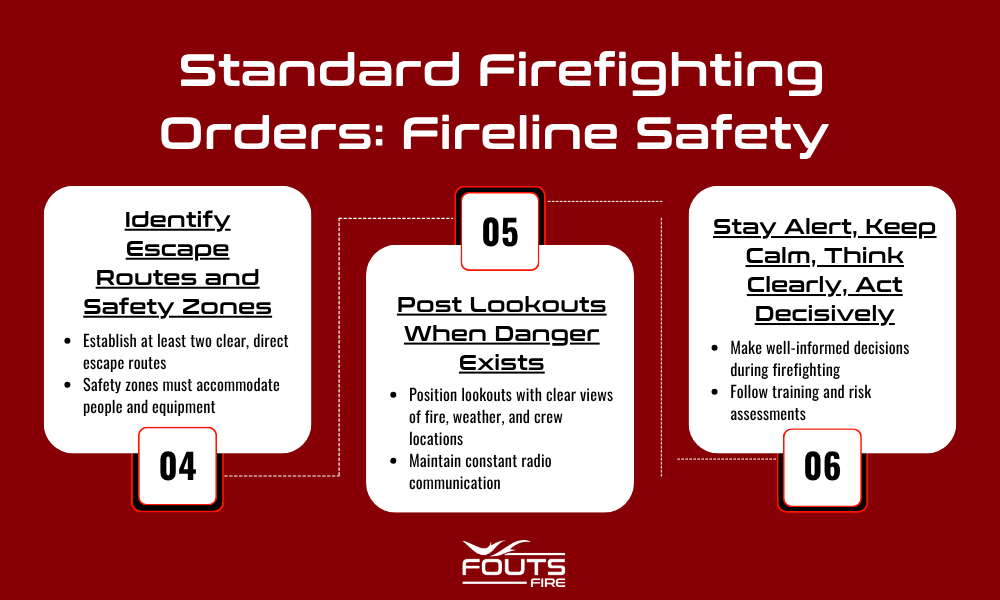
The second group of Standard Firefighting Orders focuses on wildland firefighter safety and situational awareness. These fire orders outline specific requirements for escape planning, lookout positioning, and maintaining mental clarity during firefighting operations.
Order 4: Identify Escape Routes and Safety Zones
Wildland firefighters must establish at least two escape routes from their work area to safety zones. These escape routes need to be direct, clearly marked, and free from obstacles. Safety zones should be large enough to accommodate all crew members and equipment, located uphill when possible, and cleared of combustible materials. Firefighting team leaders must ensure every firefighter knows these routes and can reach them within 30 seconds.
Order 5: Post Lookouts When There is Possible Danger
Lookouts serve as the eyes and ears of wildland firefighting operations. They must be positioned in locations with clear views of fire behavior, weather conditions, and crew locations. Lookouts also need reliable radio communication with all team members to maintain constant contact. Their main tasks include-
- Monitoring the main fire
- Keeping track of weather changes
- Identifying potential hazards
- Immediately communicating observations to the crew
Order 6: Stay Alert, Keep Calm, Think Clearly, Act Decisively
This firefighting order addresses the mental aspects of firefighter safety. Firefighters must remain vigilant throughout their shift, watching for changing conditions and potential dangers. When faced with challenges, maintaining composure is paramount. Clear thinking leads to better decisions, especially during high-stress situations. Teams should follow their firefighter training, avoid rushing decisions, and take deliberate actions based on solid risk assessment.
Organizational Control Group
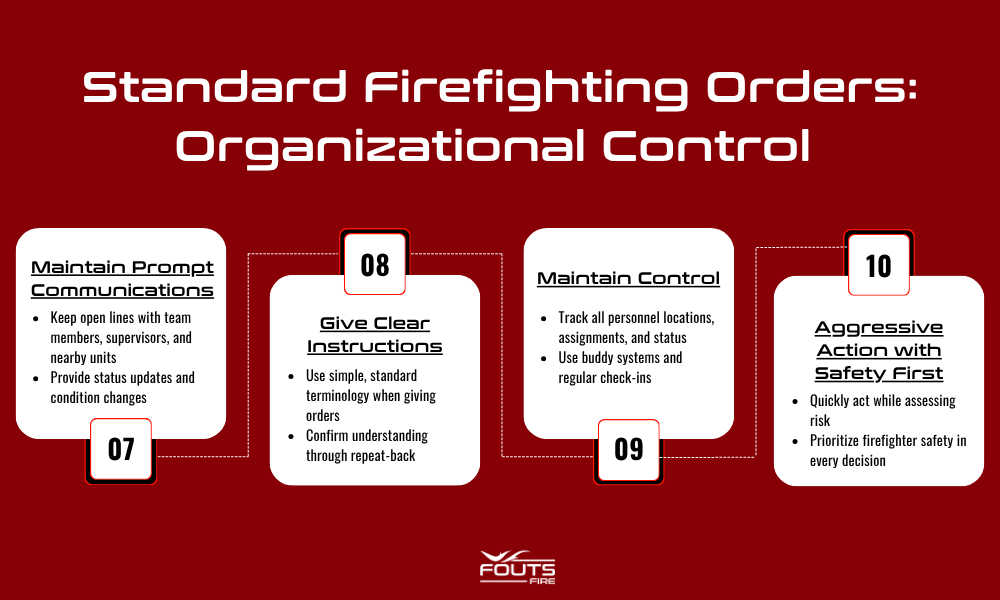
The final four Standard Firefighting Orders focus on command structure, communication, and controlled action. These orders build the framework for organized firefighting operations while maintaining safety as the top priority.
Order 7: Maintain Prompt Communications
Firefighters must keep open lines of communication with their team members, supervisors, and neighboring units. Radio systems serve as the primary communication tool, and many have designated channels for different groups of firefighters. Regular status updates, position reports, and condition changes allow teams working in different areas to coordinate their efforts and avoid working at cross points.
Order 8: Clear Instructions
When giving orders during firefighting operations, leaders should use straightforward language and standard terminology. After giving instructions, commanders should ask team members to repeat back orders to confirm understanding. This two-way communication prevents dangerous misunderstandings in high-pressure situations.
Order 9: Maintain Control
Fire officers must keep track of all personnel under their command throughout an incident. This includes knowing team locations, assignments, and status at all times. Crews use buddy systems and regular check-ins to maintain accountability. Leaders coordinate movements between different groups and monitor progress toward tactical objectives while keeping everyone focused on their assigned tasks.
Order 10: Aggressive Action with Safety First
Under the final order, teams take strong action against fires while constantly evaluating risks versus rewards to prioritize firefighter safety. Before fighting a fire, commanders make sure that proper safety measures are in place. This includes-
- Establishing escape routes
- Maintaining communication links
- Positioning backup teams

Using the Standard Firefighting Orders in Different Types of Fire Response Situations
Fire crews apply these firefighting orders across diverse emergency responses.
- Wildland Fires: Wildland firefighters use the orders to maintain situational awareness and establish clear command structures while battling large fires.
- Structure Fires: These demand strict application of safety measures related to escape routes and safety zones, particularly when operating inside buildings.
- Urban Interface Situations: When wildfires threaten residential areas, crew members need to blend both wildland firefighting and structure firefighting techniques while following these established fire orders.
Training & Preparation
Fire departments use the orders to conduct regular drills that simulate various emergency scenarios, allowing firefighters to practice these safety practices until they become second nature. Through training based on real-life scenarios, crews work through complex situations while following these fundamental firefighter safety principles.
LCES System
The Standard Firefighting Orders work hand in hand with other safety protocols, particularly Lookouts, Communications, Escape Routes, Safety Zones (LCES). Fire departments work these orders into their risk management systems to address potential hazards. This integration creates a complete safety framework that guides all emergency operations and firefighter training activities.
Documentation
Fire departments use detailed reporting to track how crews follow the orders during actual incidents. These reviews create valuable lessons that departments share across their organizations, helping all personnel learn from both successful operations and areas for improvement.
The combination of thorough training, practical application, and careful documentation allows the Standard Firefighting Orders to remain effective tools for maintaining firefighting safety and success. Regular evaluation and updates to training programs help departments adapt these orders to evolving emergency response needs while preserving their core safety principles.
Next Steps
The Ten Standard Firefighting Orders are time-tested safety practices that continue to guide wildland firefighters across the nation in making sound decisions under challenging conditions. Following these firefighting orders requires regular firefighter training, clear communication, and dedicated commitment from fire departments and all crew members. For more information, firefighters can access resources through the National Wildfire Coordinating Group (NWCG) and their local fire management agencies.
Prioritize Firefighter Safety with High-Quality Apparatus from Fouts Fire
At Fouts Fire, we understand the importance of fundamental safety in firefighting situations. Our range of firefighting apparatus models, including FB-94s and Commercial Crew Pumpers, are designed with advanced features to reliably support firefighters and help them follow these fire orders effectively. Find a Dealer near you to learn how our products can help your department maintain the highest standards of safety and operational excellence in the field.