

At a Glance: Airport fire trucks must meet strict FAA requirements for response times, water capacity, and firefighting foam capabilities. These specialized vehicles, known as Aircraft Rescue and Firefighting (ARFF) vehicles, require specific features based on the airport’s category and size.
When an aircraft emergency occurs, every second counts. Airport fire trucks serve as first responders in protecting passengers, crew, and valuable aircraft assets during emergency situations. These purpose-built ARFF trucks operate under Federal Aviation Administration (FAA) oversight to maintain the highest fire protection standards at airports across the United States.
Unlike standard fire trucks, these specialized vehicles have one tank containing water and one tank containing foam concentrate. ARFF vehicles must navigate airport terrain quickly, carry specific quantities of water and firefighting foam, and respond to diverse emergencies, from fuel spills to aircraft fires.
Types and Classifications of Airport Fire Trucks
Airport fire trucks are categorized based on their firefighting capacity and operational capabilities. The Federal Aviation Administration (FAA) classifies these specialized trucks into several categories, primarily determined by the amount of firefighting foam and extinguishing agents they can carry.
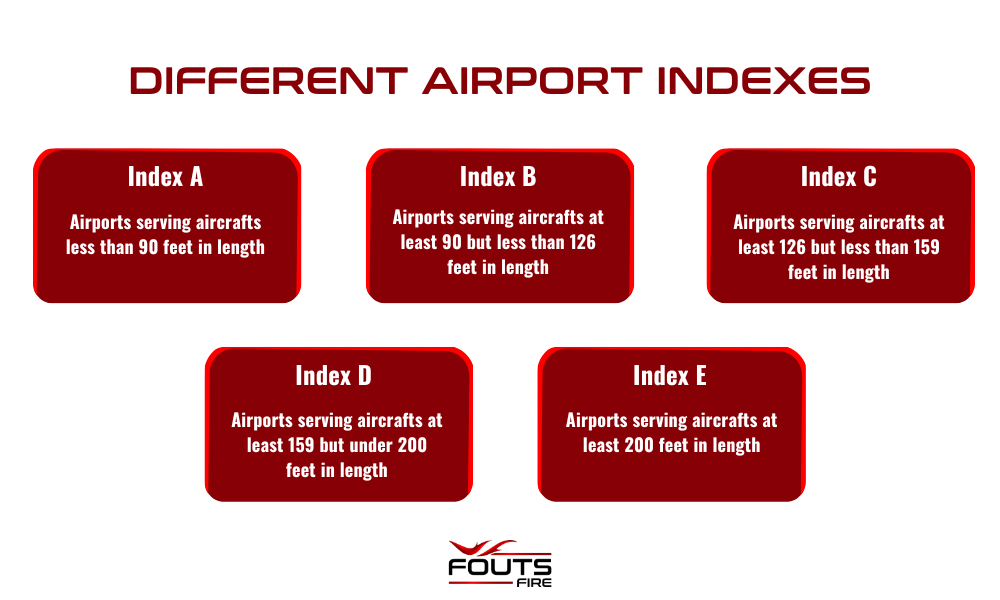
To determine required firefighting and rescue capabilities, airports are classified into one of five categories based primarily on the size of air carrier aircrafts using the airport and average daily departures-
- Index A: Applies to airports serving aircraft less than 90 feet in length
- Index B: Covers aircrafts at least 90 feet but less than 126 feet in length
- Index C: Includes aircraft from 126 to under 159 feet in length
- Index D: Applies to aircraft at least 159 feet but less than 200 feet in length
- Index E: Covers airports serving aircraft at least 200 feet in length
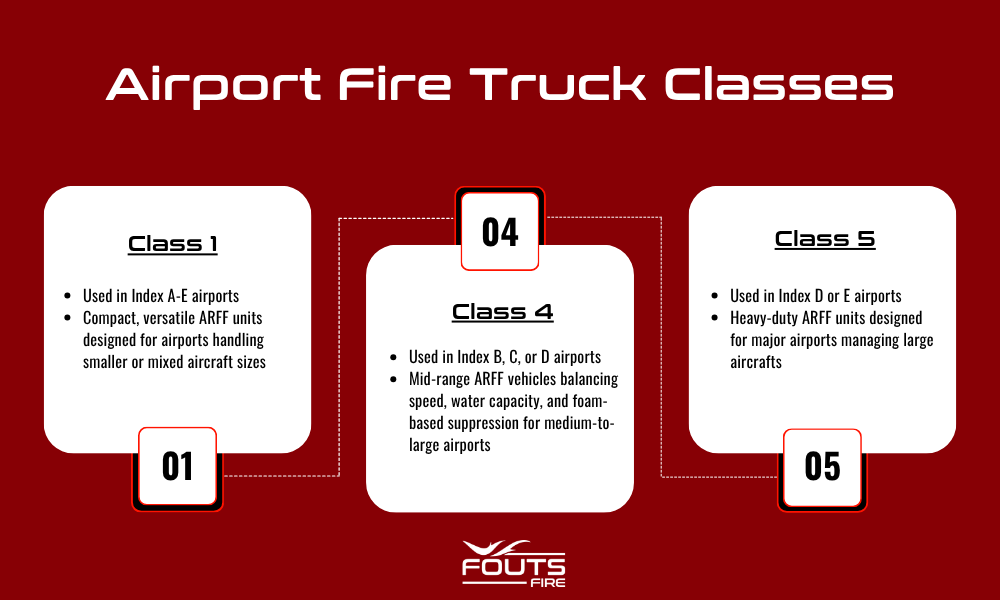
Class 1
These vehicles are used in Index A, B, C, D, and E airports. Each vehicle includes one of the following-
- A minimum of 500 pounds of sodium-based dry chemical system
- A minimum of 500 pounds of an approved clean agent system
- A minimum of 500 pounds of potassium-based dry chemical system with 100 gallons of water or foam
Class 4
These vehicles have diesel engines and are used in Index B, C, or D airports. They include a 1500-gallon water/foam fire suppression system with either-
- A 500 potassium-based Dry Chemical 279 system only
- A 500 lb sodium-based Dry Chemical 279 system only
- A 500 lb Approved Clean Agent system only
Class 5
Like Class 4 AARF vehicles, Class 5 vehicles have diesel engines, but they are only used for Index D or E airports. They include a 3000 or 4500-gallon fire suppression system with water or foam. These systems include either-
- A 500 lb Dry Chemical System Only
- A 500 lb Approved Clean Agent System Only
All three classes of these vehicles follow the National Fire Protection Association (NFPA)’s 414 performance requirements.
Most AARF vehicles include a primary water tank, foam concentrate tank, and roof-mounted turret. Advanced aircraft firefighting models add features like under-truck nozzle systems, piercing tools for aircraft fire response, and secondary hand lines.
Modern ARFF trucks typically use a 6×6 wheel configuration, though some smaller units operate on 4×4 chassis. The driver’s cab is usually centered or offset for visibility during emergency response, and firefighting controls are accessible from both stationary and cab positions.
Technical Requirements and Specifications
ARFF vehicles must meet strict technical standards to operate at airports. FAA requirements for airport fire trucks can vary based on the airport category and size, but there are a few general requirements-
Water and Foam Systems
Modern ARFF trucks use specialized fire suppression foam designed for aircraft fire incidents, which creates a blanket to suppress flames and prevent re-ignition. They must carry at least 100 gallons of water and 200 gallons of foam concentrate. However, the vehicle’s exact capacity can depend on the vehicle class.
Vehicle Performance Standards
Most airport fire trucks must reach 50 mph within 35 seconds and achieve a top speed of at least 70 mph when fully loaded. The ARFF vehicle needs to accelerate from 0 to 50 mph on a level road within 25 seconds to meet emergency call requirements.
Safety Features
Safety equipment for airport firefighters can include thermal imaging cameras, infrared sensors for low-visibility conditions, and stability control systems. The cab must have positive pressure ventilation to prevent smoke infiltration, and all controls require illumination for nighttime operations.
Operational Standards and Performance Metrics
Airport fire trucks must meet strict requirements set by aviation authorities worldwide. The Federal Aviation Administration and ICAO establish specific requirements that airports must follow to maintain their certification.
For coverage specifications, each airport category determines the required number of vehicles. The trucks must maintain complete coverage of all runway approaches, taxiways, and terminal areas.
Each airport fire truck requires two qualified airport firefighters during operational hours – one primary operator and one assistant. Larger airports maintain crews of 4-6 firefighters per shift to handle multiple vehicles and responses.
Training protocols for airport fire truck operators include:
- 40 hours of initial ARFF training
- Monthly emergency response drills
- Quarterly foam application exercises
- Annual recertification testing
Performance testing occurs through scheduled evaluations where trucks must demonstrate their capabilities in:
- Acceleration
- Foam discharge rates and distances
- Vehicle handling on both paved and unpaved surfaces
- Emergency brake system function
These standards work together to create a reliable airport fire protection system that protects airport operations around the clock.
Future Considerations
Airport fire trucks must meet strict requirements while delivering peak performance in emergency situations. Minimum water and firefighting foam capacities, acceleration times, and safety features create a foundation for reliable aircraft rescue and firefighting operations.
These airport fire trucks are continuing to evolve with technology. Electric and hybrid powertrains are emerging alongside advanced foam systems and thermal imaging. Smart monitoring systems now track truck performance and maintenance needs in real-time. When selecting new ARFF vehicles, airports should focus on parts availability, service support, and crew training programs for long-term value.
Find the Right Fire Apparatus at Fouts Fire
At Fouts Fire, we aim to provide firefighters across the country with the vehicles they need to protect their communities. Each of our standardized pumpers, tankers, and rescue vehicles is engineered for reliability, safety, and long-term service. View our full collection of apparatus models or Find a Dealer near you to get started with Fouts today.