
At a Glance: Standardized fire trucks are pre-engineered models built to set configurations, offering lower costs, faster delivery, and proven reliability, while custom apparatus are designed from the ground up to meet a department’s exact specifications. The right choice comes down to department budget, timeline, operational needs, and the specific demands of the community.
When a fire department needs a new fire apparatus, one of the first decisions leadership faces is whether to purchase a standardized model or invest in a fully custom build designed to exact specifications. Standardized fire trucks are pre-engineered models built to set configurations, while custom apparatus are designed from the ground up to meet a department’s unique requirements. Both approaches have their own benefits, and the right choice depends on budget, timeline, operational needs, and the specific demands of the community being served. Understanding how these two options differ will help you make a purchasing decision that serves your department well for years to come.
What Is a Standardized Fire Truck?
A standardized fire truck is a pre-engineered apparatus built to established specifications, with set configurations and limited room for customization. Manufacturers produce these models using consistent designs and proven components. Because the design work is already complete, standardized units move into production quickly and carry shorter lead times.
The process is straightforward. The manufacturer develops a proven design, predetermines the components and configurations, and gives departments a menu of available options to select from. Any modifications within that standard framework are minor.
Common standardized apparatus include:
- Pumpers
- Tankers
- Rescue Trucks
- Aerial Ladder Trucks
- Mini Pumpers
- Quick Attack Vehicles
With a standardized model, departments can still add personalization, such as paint color and graphics, radio and communication systems, and lighting options.
What Is a Custom Fire Truck?
A custom fire truck is designed and built to a department’s own specifications through a ground-up process that invites extensive input. Instead of selecting from a fixed lineup, the department shapes the apparatus around its exact operational requirements, resulting in a unique vehicle configuration.
The workflow begins when the department develops detailed specifications and consults closely with the manufacturer. Engineers then design the apparatus for those specific requirements, the department reviews and approves the plans, and production follows the finalized specifications.
With a custom truck, nearly every element is open for customization, including:
- Chassis selection and configuration
- Pump capacity and placement
- Tank size and material
- Body construction
- Cab configuration and seating
Departments typically choose the custom apparatus when they face unique operational requirements, specific geographic or terrain challenges, a need to match an existing fleet, specialized rescue needs, or simply very particular preferences.
Key Differences Between Standardized and Custom
Design Process
A standardized purchase involves selecting from existing options and making a limited set of decisions. A custom build involves developing specifications from scratch with department input at every stage. Because of this, standardized models carry shorter production times and may even have units ready for immediate delivery. Custom apparatus models are built only after specifications are finalized, which extends the schedule considerably.
Cost
Standardized trucks generally offer a lower purchase price and predictable pricing, while custom builds require a higher upfront investment that varies with the specifications chosen.
Flexibility & Consistency
Standardized apparatus models keep departments within established parameters but deliver proven, uniform configurations that simplify parts sourcing and training. Custom apparatus adapt to nearly any requirement and open the door to innovation, though they are unique to each department and may call for specialized training.
Advantages of Standardized Fire Trucks
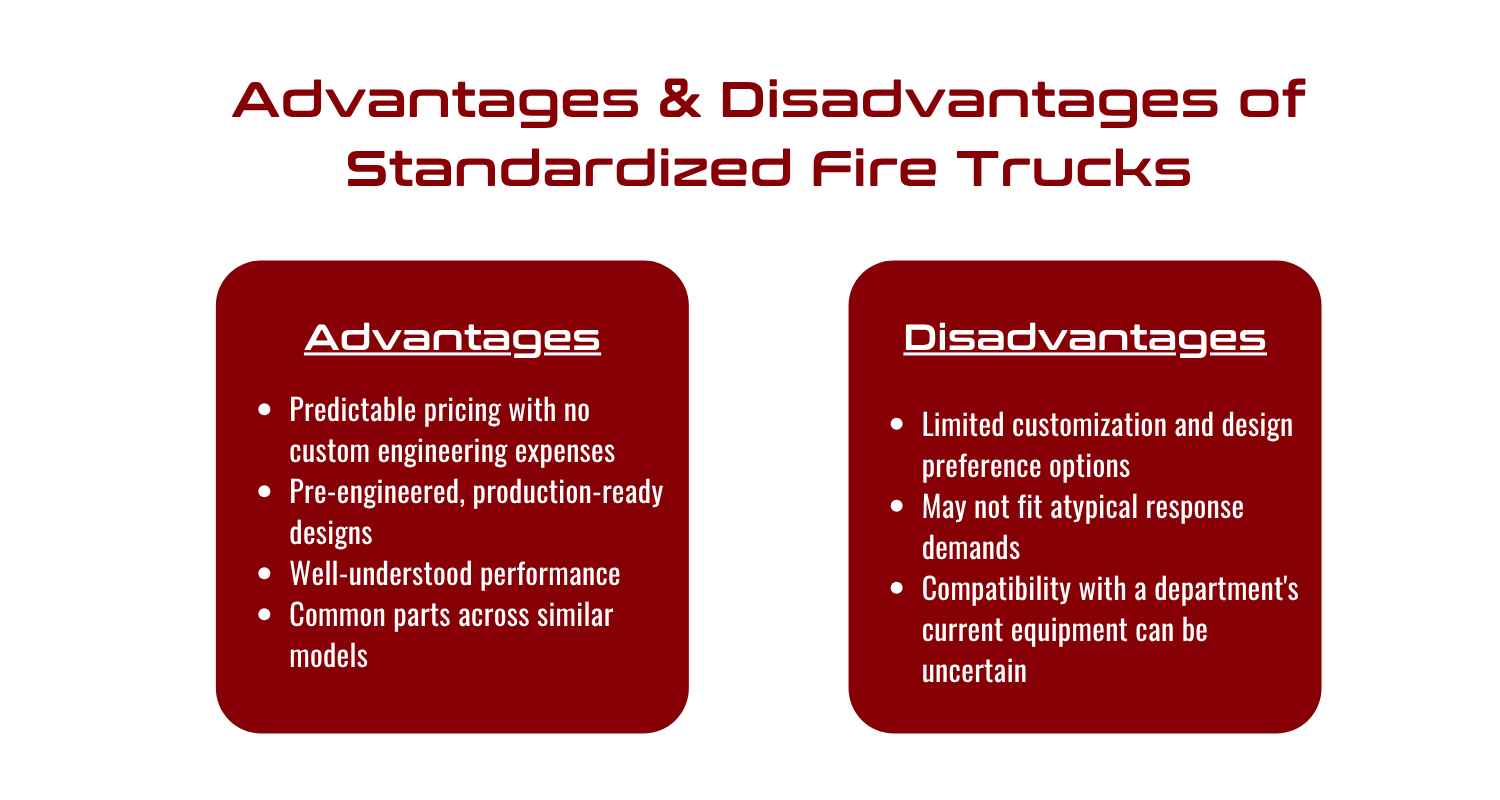
- Cost: Economies of scale in manufacturing, the absence of custom engineering expenses, and predictable pricing make standardized trucks a budget-friendly choice for cost-conscious departments
- Faster Delivery: Pre-engineered designs are ready for production, the manufacturing process is streamlined, and some units may already sit in inventory, which reduces wait time and helps departments respond to urgent needs.
- Proven Reliability: Standardized designs have been tested across many departments. Their performance characteristics are well understood, and any issues have usually been identified and resolved over time.
- Simplified Maintenance: Since common parts appear across similar models, mechanics recognize the systems, and replacement components are readily available.
- Training Benefits: Consistent controls and layouts mean firefighters often bring prior experience and face a shorter learning curve.
Disadvantages of Standardized Fire Trucks
- Limited Customization: Departments must work within the available options, which may not perfectly fit their needs or design preferences.
- Location-Specific Requirements: When a community has unusual demands, such as difficult terrain or atypical response requirements, a one-size-fits-all model may not accommodate all their needs.
- Existing Equipment Connection: Compatibility with existing equipment can also be uncertain.
Advantages of Custom Fire Trucks
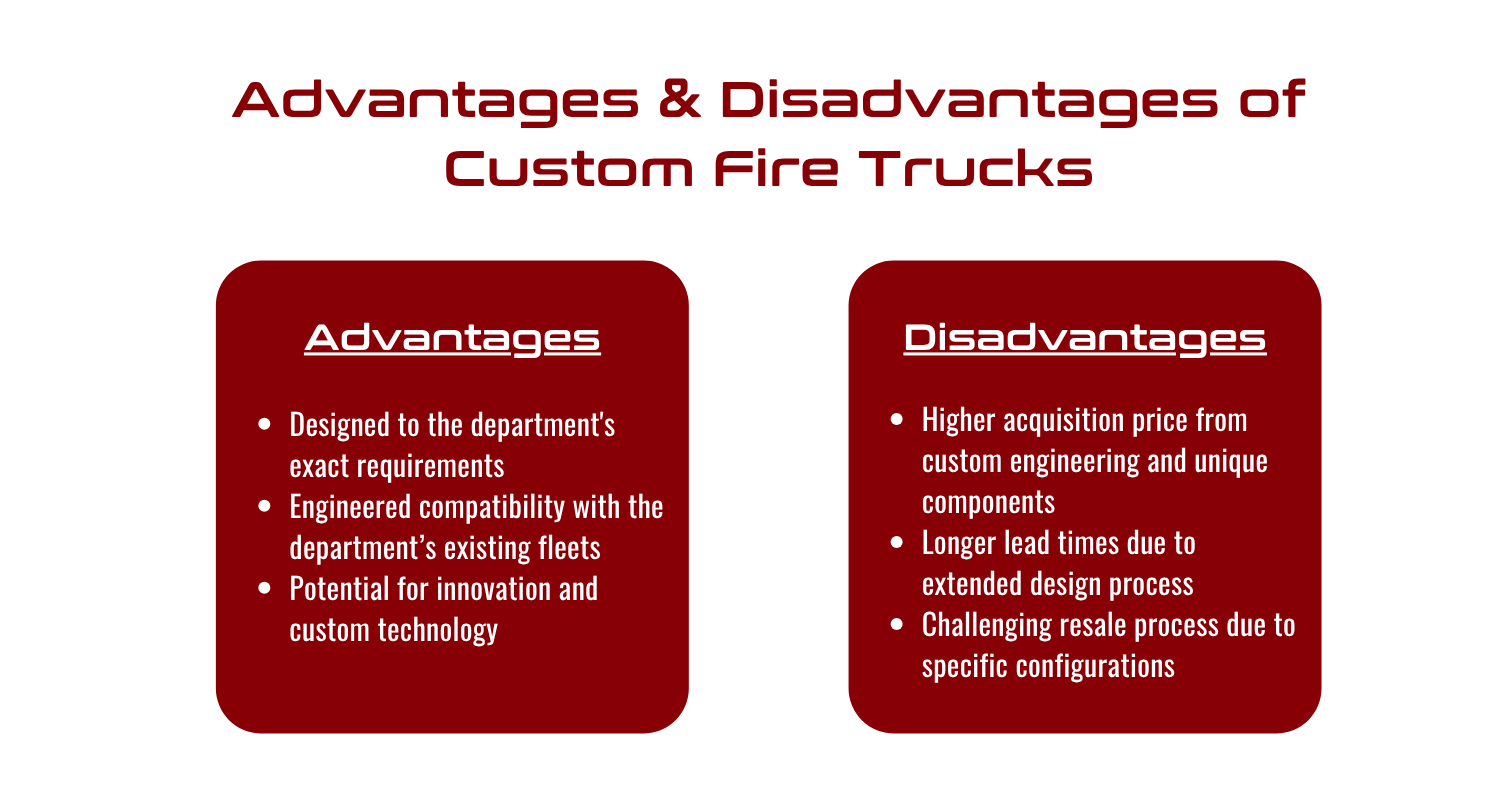
- Precision: A custom emergency vehicle is designed to the department’s exact requirements. Every feature is selected intentionally, and there are no unnecessary components weighing down the truck or the budget.
- Existing Equipment Connections: Compatibility with an existing fleet can be engineered in from the start.
- Potential for Innovation: Custom builds also create room for innovation, letting departments incorporate the latest technology and develop new solutions alongside the manufacturer.
Disadvantages of Custom Fire Trucks
- Higher Purchase Cost: Custom engineering, unique components, an extended design process, and premium specialized features all add expense, raising the total acquisition price.
- Longer Lead Times: Specification development, custom engineering, and production that begins only after the design is approved can push delivery to twelve to twenty-four months or more.
- Increased Complexity: A custom build demands more decisions from the department, calls for specification expertise, and carries the risk of overlooking important details or making specification errors.
- Additional Maintenance Needs: Unique components may be harder to source, parts may take longer to arrive, and mechanics may need specialized training.
- Challenging Resale Process: Since highly specific configurations narrow the pool of future buyers and may lower resale value when the time comes to replace the apparatus.
Factors to Consider When Choosing an Apparatus
Budget & Time Constraints
Departments should weigh available funding, total cost of ownership, financing options, grant requirements, and long-term budget planning before settling on an approach. Timeline requirements matter just as much, because the urgency of the need, the condition of the current fleet, and the ability to wait for a custom build all shape what is realistic.
Operational Requirements
The specific needs of the response area, any unusual terrain factors, specialized services provided, fleet compatibility, and crew workflow. Department resources are equally important, since specification development takes staff expertise and time, and long-term support depends on in-house maintenance and training capacity.
Manufacturer Relationships
Consider a builder’s reputation, warranty and service support, geographic proximity, and track record with departments like yours.
Making the Decision
Before picking out a standardized or custom fire apparatus, start by asking the right questions:
- Identify your non-negotiable requirements
- Determine where standard configurations will serve
- Establish a realistic budget
- Decide how urgently the apparatus is needed
- Assess the resources available for specification development
From there, evaluate your options by:
- Requesting apparatus quotes
- Comparing total cost of ownership
- Considering the operational impact of any compromises, and factoring in delivery timelines.
- Gathering input from the firefighters who will use the apparatus
Once a decision is made, make sure to:
- Secure budget approval from the appropriate authorities
- Consult the maintenance team
- Account for training implications and community expectations
- Document requirements clearly
- Plan for delivery and future growth
How to Choose the Right Apparatus
Standardized fire trucks offer lower costs, faster delivery, and proven reliability, while custom fire trucks provide exact specifications, address unique challenges, and optimize operational efficiency for a department’s specific needs. The right choice depends on budget, timeline, operational requirements, and the demands of the community you serve. Evaluate your department’s priorities, budget, and operational requirements to determine whether a standardized or custom approach is the best option to protect your community.
Find the Right Fire Equipment with Fouts Fire
At Fouts Fire, we are proud to be one of the leading standardized fire truck manufacturers in North America. Instead of producing custom models with long lead times and complex deliveries, we distribute dependable, high-quality models that are built to meet the complex safety needs of fire departments in North America.
Explore our standardized fire apparatus models, including our pumpers, tankers, and rescue apparatus, or Find a Dealer near you to get started today.